 Compass2Germany
New in Germany? How to Set Up Health Insurance, a Bank Account and Transport in 3 Steps (2026 Guide)

New in Germany as a student? Get three things set up in your first weeks: health insurance, a bank account and a transport ticket. Health insurance is compulsory, and your university won't let you enrol without proof of it. Most students under 30 join a public fund such as TK insurance at a fixed student rate (about €141 to €146 a month with TK in 2026). You need a German bank account to receive the €992 a month released from your blocked account, plus any part-time wages, and to pay rent. For getting around, check your semester fee first: many universities already include the Deutschlandsemesterticket, which costs much less than the regular €63 Deutschlandticket. Below are the step-by-step sign-ups for each, for students and for anyone starting a job, plus honest tips so you avoid the mistakes most newcomers make.
In this article
- What do I need before I start?
- How do I get health insurance in Germany?
- Which bank account should I open in Germany?
- How do I get the Deutschlandticket and use transport apps?
- FAQ
What do I need before I start?
Most sign-ups ask for the same few documents, so gather them once:
- Passport (or EU ID card) and your visa or residence permit if you have one
- Anmeldung (your address registration certificate from the Bürgeramt)
- Tax ID (Steuer-ID), which arrives by post a few weeks after your Anmeldung
- Your university admission letter (Zulassungsbescheid), or your employment contract if you’re coming to work
- Your blocked account confirmation (Sperrkonto), if you needed one for your student visa
- A smartphone with a German or EU number for video ID checks and banking apps
Compass2Germany tip: do it in this order: Anmeldung, then health insurance (your university needs it before you can enrol, and an employer needs it before your first payslip), then a bank account, then transport. If you don’t have your Anmeldung yet, Revolut can bridge the gap (see below).
How do I get health insurance in Germany?
Everyone living in Germany must have health insurance. Students at a German university are normally insured in a public fund (Krankenkasse) at a special student rate until the end of the semester in which they turn 30. Employees earning under €77,400 gross a year (the 2026 limit) must also join a public fund. Either way, you choose which one. Public funds all cover the same core treatment by law, so you are really comparing the extra contribution, the service and the extras.

Why do so many expats choose TK?
Techniker Krankenkasse (TK) is Germany’s largest public health insurer, with more than 12 million people insured. For newcomers, the biggest win is that the application is fully in English, the TK app is in English, and English-speaking advisers are available 24/7. It also charges less than average. In 2026 TK’s total rate is 17.29% of your gross salary (14.6% general rate plus a 2.69% extra contribution), against an official average extra contribution of 2.9%. If you’re employed, your employer pays roughly half. Family members without their own income can often be covered for free.
How much does health insurance cost for students?
Students pay a fixed monthly amount set by law, not a percentage of income, so it doesn’t rise if you take a part-time job. With TK in 2026 it looks like this:
| Who | Health + long-term care | Total per month |
|---|---|---|
| Student under 23 | €110.38 + €30.78 | €141.16 |
| Student 23 or older, no children | €110.38 + €35.91 | €146.29 |
| Employee | 17.29% of gross salary, about half paid by your employer, plus care insurance | Depends on salary |
Honest tip for students: the student rate is only for students enrolled at a university. If you’re in a language course or a Studienkolleg, or you’re over 30, ask TK which insurance applies to you before you arrive. Be careful with very cheap private “student” plans: if you choose private insurance at the start of your studies, you usually can’t switch back to public insurance until your studies end.
English online application, English app and 24/7 English support. Accepted for visa applications.
How do I sign up for TK insurance, step by step?
- Open the English application. Go to the TK insurance sign-up page and choose your status. Students pick "student" and add their university.
- Enter your details. Add your name, German address, date of birth, nationality and employer details. Have your passport and employment contract ready.
- Add your previous insurance. If you were insured in another EU country or with another German fund, enter it here. TK can cancel your old German fund for you.
- Send the application. TK takes over from here. You can follow progress with the "TK Boarding" status checker.
- Upload your photo. When TK asks, upload a passport-style photo for your eHealth card (Gesundheitskarte).
- Confirm your insurance where it's needed. Students: TK sends your insurance confirmation to your university electronically, so you can enrol. Employees: send your membership confirmation (Mitgliedsbescheinigung) to HR so contributions come straight out of your salary.
- Install the TK app. Use it to download certificates for your employer or the immigration office (Ausländerbehörde), upload sick notes and book appointments.
What are the alternatives to TK?
Other large public funds include AOK (organised regionally), Barmer, DAK and hkk. Some cost slightly less (hkk’s extra contribution is 2.59% in 2026) and some cost more (DAK is 3.2%). What you get in English and how easy the app is differs more than the price, which is why TK is so popular with newcomers. Private insurance is only an option if you earn above €77,400, are self-employed, or are a civil servant. Think carefully before you go private, because switching back to public insurance later can be difficult.
Which bank account should I open in Germany?
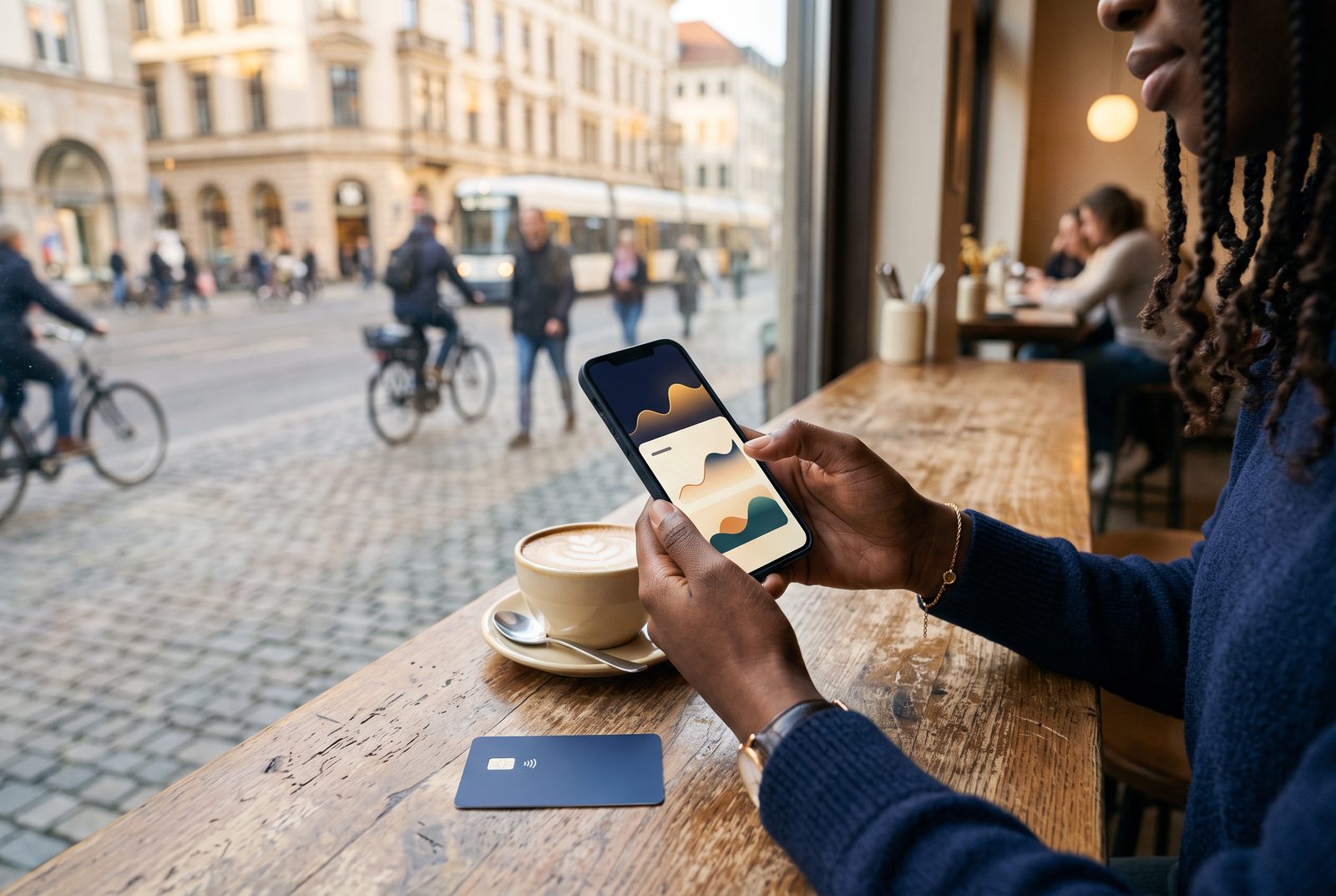
You need an account with a German IBAN (it starts with “DE”) to receive money from your blocked account, part-time wages or a salary, and to pay rent and bills. Your choice depends on whether you want a traditional bank, an app-only bank, or both. Many newcomers open Revolut first (fast, no credit check), then add Commerzbank once they’re settled.
| Option | Best for |
|---|---|
| Commerzbank Traditional bank with branches and ATMs. German IBAN: yes | A long-term main account, cash deposits, English online banking |
| Revolut App-only bank. German IBAN: yes, for new customers living in Germany | A quick start, no credit check, travel and currency exchange |
| PayPal Online payment service, not a bank account. Links to your bank | Online shopping, paying friends, buyer protection |
| N26 / Wise App-based alternatives. German IBAN: N26 yes; Wise varies | A second account; Wise for sending money abroad |
Do I need a blocked account as a student?
If you need a visa to study in Germany, you usually have to prove you can support yourself. Most students do this with a blocked account (Sperrkonto): in 2026 you deposit €11,904 for one year before your visa appointment. After you arrive, €992 is released to you each month. Specialist providers such as Expatrio, Fintiba and Coracle offer these accounts, and their fees differ, so compare them before you choose. A blocked account is not an everyday bank account. The monthly €992 has to be paid out into a normal current account, which is why you need one of the accounts below as soon as you have your Anmeldung.
How do I open a Commerzbank account, step by step?
To open a Commerzbank account you need to be at least 18, live in Germany and be tax-registered here. Have your passport, Anmeldung and tax ID ready. The whole application takes around 10 to 20 minutes.
- Start online. Open the Commerzbank account page and click "Kostenloses Girokonto eröffnen" (open a free current account).
- Fill in the form. Enter your personal details, address, nationality, job and tax ID, then click "Antrag erstellen" to submit.
- Verify your identity. Choose VideoIdent (a short video call with your passport, using the Commerzbank IDENT app) or PostIdent at a Deutsche Post branch. PostIdent only accepts your original passport, not copies.
- Activate online banking. Set up photoTAN in the Commerzbank app. Online banking is usually ready 1 to 2 business days after your ID check.
- Receive your card and PIN. Your girocard and its PIN arrive separately by post. Then share your new IBAN with your employer and landlord.
Honest tip: Commerzbank sometimes runs a welcome bonus for new online customers. Check the current conditions before you apply, because these offers usually require you to use the account actively for a few months.
Open it in the app in minutes. No Schufa credit check, and new customers living in Germany get a DE IBAN.
How do I open a Revolut account, step by step?
- Download the app. Get Revolut through this link and enter your phone number.
- Add your details. Enter your name, date of birth, email and German address.
- Verify your identity. Photograph your passport or ID card and take a short selfie video in the app.
- Choose a plan. The Standard plan is free. Paid plans add extras such as higher limits and insurance, so start free and upgrade only if you need to.
- Find your IBAN. Tap Accounts on the home screen to see your German IBAN, then share it with your employer.
- Order your card. Use the virtual card right away in Apple Pay or Google Pay while your physical card is on its way.
Honest tip: Revolut is a Lithuanian-licensed bank with a German branch. Deposits are protected up to €100,000 under the Lithuanian deposit scheme. It’s a great everyday account, but many people also keep a traditional German bank for things like mortgages and long-term savings.
How do I open an N26 account, step by step?
N26 is a Berlin-based app bank with a full German banking licence and a German IBAN. It’s a popular alternative to Revolut if you want a German bank that lives entirely on your phone.
- Download the app. Sign up through this N26 link and switch the app to English.
- Enter your details. Add your name, email, phone number and German address.
- Choose your plan. The Standard account is free; paid plans add extras such as insurance and more free ATM withdrawals.
- Verify your identity. Follow the in-app ID check with your passport or ID card.
- Pair your phone and start banking. Your IBAN appears in the app straight away and your card arrives by post.
How do I set up PayPal in Germany, step by step?
PayPal is everywhere in German online shopping, so it’s worth setting up once you have a bank account.
- Sign up. Go to PayPal Germany and click "Neu anmelden" (sign up). Choose a personal account.
- Enter your details. Add your email, a strong password, your name, German address and phone number.
- Confirm your email. Click the link PayPal sends you.
- Link your bank account. Add your new IBAN (Commerzbank, Revolut or N26) so PayPal can take payments by direct debit (Lastschrift). PayPal may confirm the link, for example with small test payments.
- Add a card (optional) and turn on two-step login for extra security.
How do I get the Deutschlandticket and use transport apps?
The Deutschlandticket costs €63 a month in 2026 and covers almost all local and regional public transport in Germany: buses, trams, U-Bahn, S-Bahn and regional trains. It is 2nd class only and does not cover long-distance ICE or IC trains. It’s a monthly subscription, not a one-off ticket, and you must cancel by the 10th of the month for it to end at the end of that month.

Heads up for 2027: the price rises to €66.80 a month from 1 January 2027. If you already subscribe through DB, you have to agree to the new price by 30 November 2026. Otherwise DB will end your subscription on 31 December 2026. If your employer offers a Jobticket, ask HR, because your share can drop significantly.
Do students need to buy the Deutschlandticket?
Often, no. Many universities include the Deutschlandsemesterticket in the semester fee (Semesterbeitrag) you pay when you enrol. It’s the same nationwide ticket at 60% of the price: €37.80 a month (€226.80 per semester) from winter semester 2026/27. You usually get it in your university’s or local transport app. Prices and rules can differ in some regions, such as Bavaria. Check your semester fee breakdown for a line called “Deutschlandsemesterticket” before you buy anything, so you don’t end up paying twice. If your university doesn’t include it, or you arrive before your semester starts, buy the regular Deutschlandticket with the steps below.
How do I buy the Deutschlandticket in the DB app, step by step?
- Download DB Navigator (the official Deutsche Bahn app) and switch the language to English in the settings.
- Create a DB account. Register with your email, confirm the link DB sends you, and log in.
- Find the ticket. Search for “Deutschland-Ticket” and choose the month you want it to start.
- Enter your details and payment. The subscription is usually paid by SEPA direct debit, which is why you should open your bank account first.
- Open your ticket. It appears in the app (under your trips/tickets) as a QR code and is also emailed to you. Show it with your ID during checks.
- Use the app for every trip. Turn on “Nur Nahverkehr” (local transport only) when planning routes so you don’t accidentally pick an ICE.
Pay by credit card, PayPal, Apple Pay, Google Pay, Klarna or Revolut. QR ticket in Apple or Google Wallet.
How do I get the Deutschlandticket on mopla, step by step?
mopla is a licensed seller of the same official Deutschlandticket. The ticket is identical to DB’s; what’s different is the payment options, which makes mopla useful if you only have a foreign card.
- Download mopla through this link (or use the web app).
- Register with your email and confirm your account. You must be at least 16.
- Choose the Deutschlandticket and your start month.
- Pick a payment method: credit card, PayPal, Apple Pay, Google Pay, Klarna, Revolut or direct debit.
- Save the QR ticket to Apple Wallet or Google Wallet.
- Pause or cancel in the app when you don't need it, by the 10th of the month.
Honest tip: mopla used to let you cancel until shortly before the end of the month, but since April 2026 its deadline is the 10th, the same as everyone else. App reviews are mixed, with complaints mainly about price-change emails and billing. Read every email mopla sends you about price changes, and put the 10th of each month in your calendar.
| DB Navigator | mopla | |
|---|---|---|
| Ticket price (2026) | €63/month | €63/month |
| Payment | Mainly SEPA direct debit | Card, PayPal, wallets, Klarna, Revolut, direct debit |
| Cancel or pause by | 10th of the month | 10th of the month (pause button in app) |
| Also does | Journey planner, long-distance tickets, live delays | Jobticket link, on-demand buses in some regions |
Our honest setup: buy your Deutschlandticket wherever payment suits you, and keep DB Navigator on your phone anyway. It’s the best app for planning routes and checking live delays.
Want a free, honest checklist for your first month in Germany?
Get the free Compass2Germany guide: Anmeldung, insurance, banking and more, explained in plain English.
Get the free guide →Frequently asked questions
Can I open a German bank account without an Anmeldung?
Traditional banks like Commerzbank usually need you to be registered and tax-resident in Germany. App banks such as Revolut are easier to open while you wait, and new customers living in Germany get a German IBAN.
How much is health insurance for international students in Germany?
Students under 30 who are enrolled at a German university pay a fixed student rate in public insurance. With TK in 2026 it’s €141.16 a month if you’re under 23, or €146.29 if you’re 23 or older without children, including long-term care insurance.
Is TK insurance accepted for a German visa?
Yes. TK is a statutory (public) health insurer, which is accepted for visa and residence permit applications. Once you’re a member, you can download proof of insurance for the immigration office in the TK app.
How much does public health insurance cost for employees?
It’s a percentage of your gross salary, not a flat fee. With TK in 2026 the total is 17.29%, and employees pay roughly half while their employer pays the rest. Long-term care insurance (Pflegeversicherung) is charged on top.
Does the Deutschlandticket work on ICE trains?
No. It covers local and regional transport in 2nd class only. For ICE and IC trains you need a separate DB ticket, such as a Sparpreis fare.
When do I have to cancel my Deutschlandticket?
By the 10th of the month, for it to end at the end of that month. This applies with DB and, since April 2026, with mopla too.
Settle into Germany with less stress
Whether you're here to study or work, start with the essentials: join TK insurance, open your bank account, and grab your Deutschlandticket. Then follow us for weekly honest tips.
Prices and rules checked November 2026. Always confirm current conditions with each provider before you sign up.
Some links in this guide are affiliate links (Anzeige). If you sign up through them, Compass2Germany may earn a small commission at no extra cost to you. Read our affiliate disclosure.